

September 2026 · q3 Update
Our second quarterly update: what we've worked on since June, where each project stands, and where you can help.

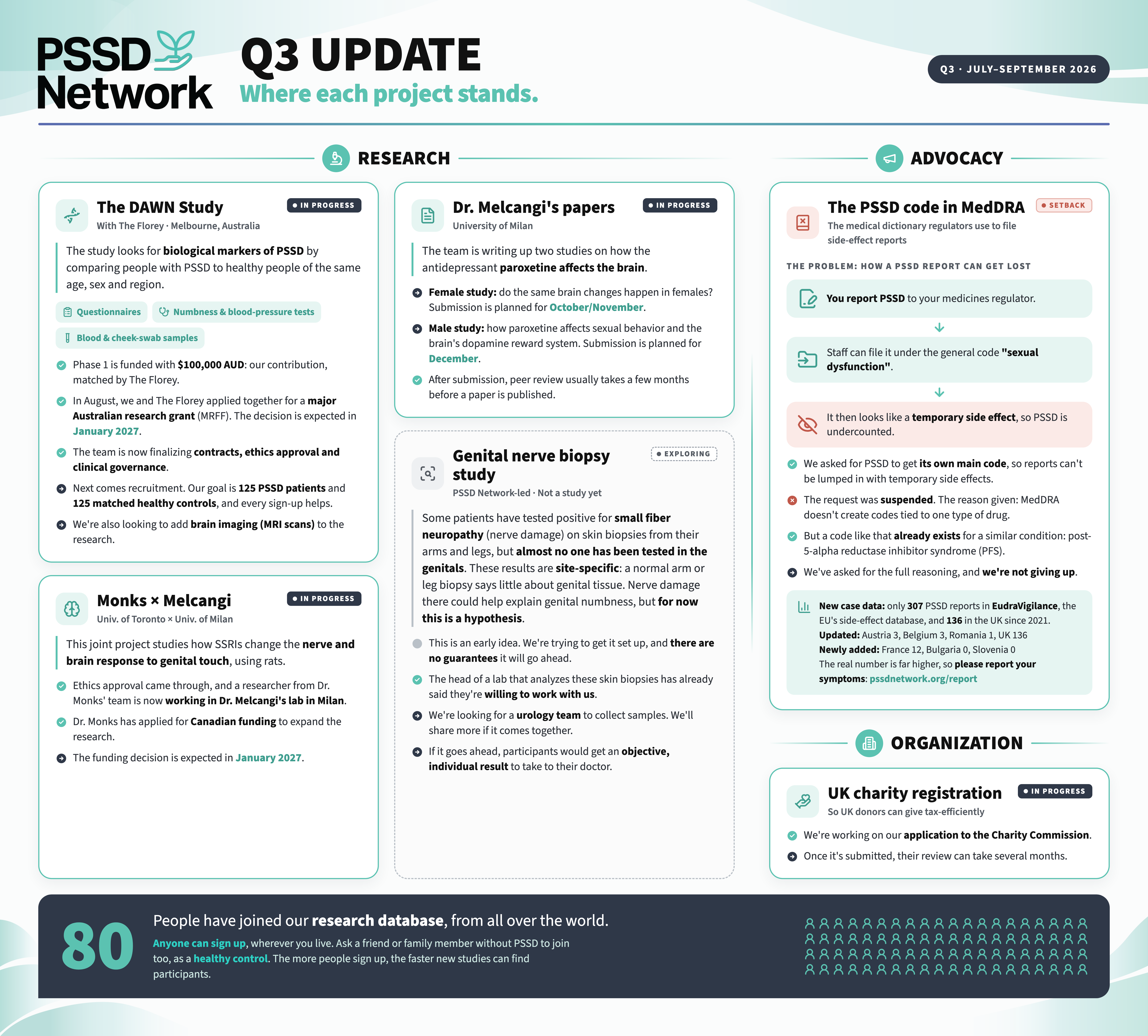

In June we announced The DAWN Study, which we are running with The Florey Institute of Neuroscience and Mental Health, affiliated with the University of Melbourne. The study is led by the Florey's Neuroepidemiology Research Group. Phase 1 is funded with $100,000 AUD: the PSSD Network's contribution, matched by The Florey. The Florey research team has sent us the following update.
In August, The Florey and the PSSD Network together applied for a Medical Research Future Fund (MRFF) Consumer-Led Research Grant. The grant would fund a comprehensive study of the biological underpinnings of SSRI post-exposure syndrome. Results are expected in January 2027.
Meanwhile, the team is preparing a smaller, preliminary study. Before data collection can begin, it is finishing three administrative and regulatory steps:
- Clinical governance: making sure all institutional protocols and safety standards are met.
- Contracts: finalizing the legal agreements between the participating organizations.
- Ethics amendment: getting formal ethical approval for changes to the study.
DAWN is a population-based study with matched case-controls. Its design is based on the earlier Ausimmune study of multiple sclerosis (Lucas et al., 2007). Ausimmune recruited people across Australia and compared them with controls matched on age, sex and region, which is the same approach DAWN will use. Ausimmune began years ago and is still producing useful findings today: a 2025 paper in Annals of Neurology used its data to show how several risk factors for MS act through shared epigenetic pathways (Simpson-Yap et al., 2025).
DAWN aims to uncover markers of the condition through:
- Detailed questionnaires: gathering thorough data on patient histories and symptom profiles.
- Physical examinations: measuring objective signs of dysfunction, including tests for skin anaesthesia (numbness) and postural hypotension (a drop in blood pressure when standing up). These show whether the autonomic nervous system is affected.
- Biosamples and lab tests: for example blood hormone levels, epigenetics from a cheek (buccal) swab, and genomics.
We're also looking to add brain imaging (MRI scans) to the research.
We'd love to reach 125 PSSD patients and 125 matched controls. It isn't a hard minimum, but the more people take part, the stronger the results, and every sign-up brings us closer. Controls are people without PSSD who are matched to PSSD participants by age, sex and region. They are the direct comparison group, and they must be tested at the same time as the PSSD participants so the data is accurate and unbiased.
Anyone can sign up to the research database, wherever you live. Please also ask a friend or family member without PSSD to sign up as a control. Without enough matched controls, the study can't go ahead.
References▾
- Lucas RM, Ponsonby A-L, McMichael AJ, et al. Observational analytic studies in multiple sclerosis: controlling bias through study design and conduct. The Australian Multicentre Study of Environment and Immune Function. Multiple Sclerosis. 2007;13:827–839. doi:10.1177/1352458507077174
- Simpson-Yap S, Morwitch E, Tanner SA, et al., for the Ausimmune Investigator Group. Epstein–Barr Virus, Lower Vitamin D, Low Sun Exposure, and HLA-DRB1*1501 Risk Variant Share Common Epigenetic Pathways Leading to Multiple Sclerosis Onset. Annals of Neurology. 2026;99(2):341–355. doi:10.1002/ana.78043
In our last update we said Dr. Ashley Monks (University of Toronto) was working to send a researcher to Professor Melcangi's lab in Italy. Ethics approval has come through, and the researcher is now working in Professor Melcangi's lab in Milan. The project will study how SSRIs affect behavioral and neural responses to genital stimulation in the rat paroxetine model.
Dr. Monks has also submitted the joint grant application to the Canadian government that we mentioned in June. If it's approved, the teams can widen the research, for example by testing SSRI effects in a mouse model. The decision is expected in January 2027.

Professor Melcangi updated us in September. Both of the paroxetine studies we described in June are now being written up:
| Paper | Planned submission |
|---|---|
| Paroxetine in female rats | October/November 2026 |
| Paroxetine and dopamine in male rats | December 2026 |
- Male rat study: how paroxetine treatment and withdrawal affect sexual behavior, building on the team's earlier findings of dopamine dysfunction in the nucleus accumbens, a core brain region for reward and motivation.
- Female rat study: whether the same brain changes happen in a female model. Women are prescribed antidepressants more often, yet female sexual dysfunction is still heavily under-recognized.
We know many of you have been waiting a long time for these papers, and we understand the frustration. Submitting a paper is not the same as publishing it: peer review usually takes several months and can involve revisions. We'll share each paper as soon as it's published.
This is a new project and a PSSD Network-led initiative.
Some PSSD patients have tested positive for small fiber neuropathy (SFN) on skin biopsies taken from the arms and legs. However, almost no one has been tested in the anatomical region where sensory symptoms are often most pronounced: the genitals.
Importantly, intraepidermal nerve fiber density (IENFD) biopsy findings are highly anatomically site-specific. A normal or abnormal result from the leg or arm does not necessarily establish the nerve fiber density in genital tissue. If PSSD involves localized or non-length-dependent changes affecting genital sensory fibers, biopsies from conventional sites may therefore fail to capture them.
Nerve fiber loss or abnormalities within genital tissue could potentially help explain symptoms such as genital numbness, but at present this remains a hypothesis that requires direct investigation.
We believe a genital-specific skin biopsy study could also provide something PSSD research has rarely been able to offer: an objective, individual tissue-based result that participants can take back to their treating doctors, while simultaneously generating systematic data about whether peripheral small-fiber pathology is present in PSSD.
Here's where things stand:
- The head of a lab that analyzes these skin biopsies has already said they're willing to work with us.
- We're now looking for a urology team to collect the samples, and we're in early talks with potential partners.
- We're also talking to specialists in uro-neurology about how nerve damage in this area can be measured and quantified.
This study would most likely be funded directly by the community, and participants would get their own biopsy results. It's early, and it may not come together, but we want you to see what we're working on as it happens. We'll share more, including what funding it would need, once we have a partner lined up.
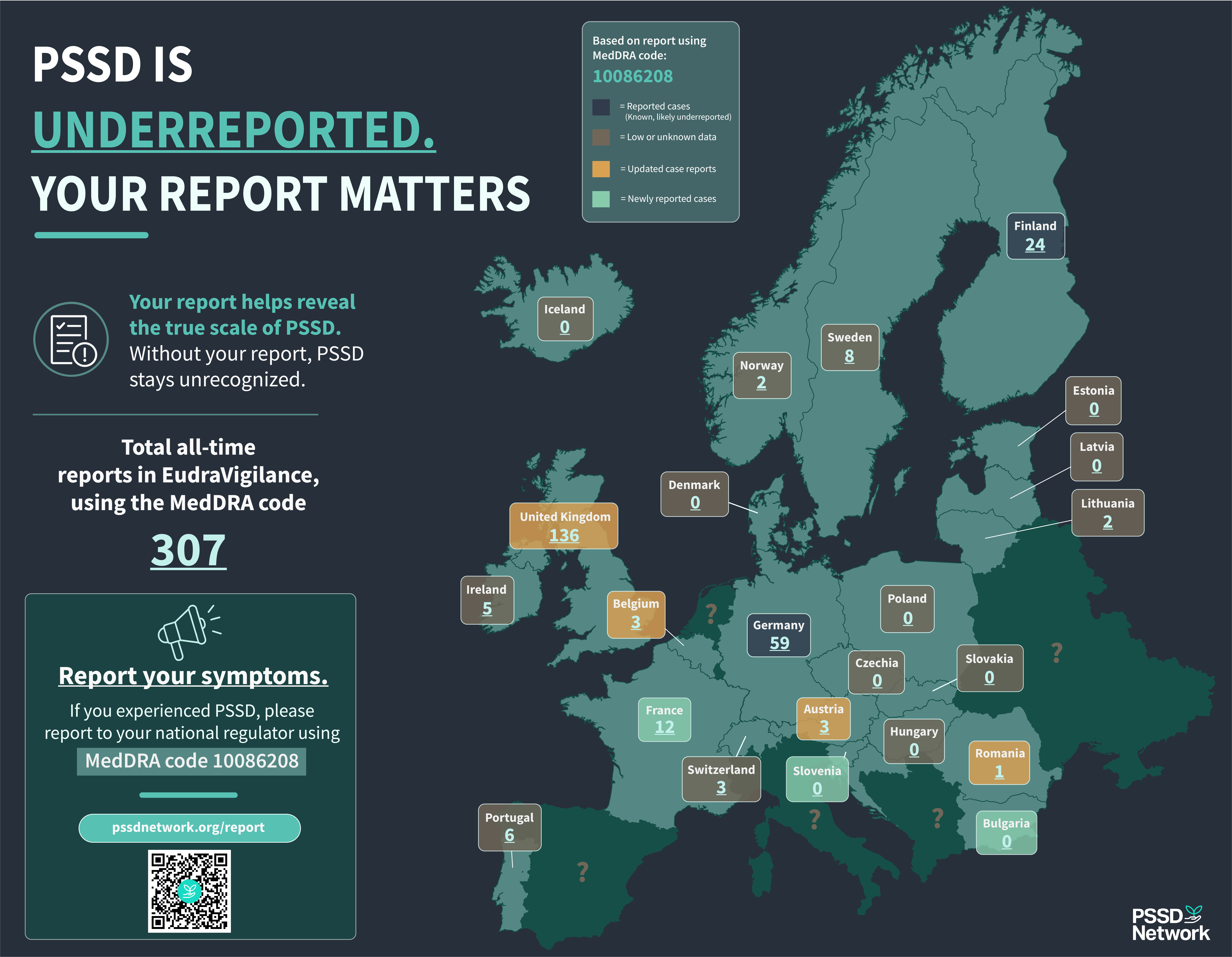
We requested official case data directly from national regulators and the EMA. Since the PSSD term was added to MedDRA in 2021, only 307 PSSD reports have been recorded in EudraVigilance, the European Medicines Agency's database of suspected side effects, and 136 by the UK regulator. Outside Europe, Canada has 13 and Australia 10. Several countries, such as Iceland, Denmark, Poland and Czechia, show zero, and some regulators haven't shared their data yet.
Since our last update, Austria (3), Belgium (3), Romania (1) and the UK (136) have sent updated figures, and three countries shared their data for the first time: France (12), Bulgaria (0) and Slovenia (0).
We know from our own community that the real number is far higher. Most people never file a report, and many reports are filed under general terms, so they are never counted as PSSD. The next section shows why that happens.
If you have PSSD and haven't reported it yet, please do it today. Report to your national medicines regulator and to FDA MedWatch, and use the term "post-SSRI sexual dysfunction" (MedDRA code 10086208).
This quarter we asked for the PSSD code to be upgraded in MedDRA, the medical dictionary that regulators around the world use to code adverse drug reaction reports. The request was suspended by the MSSO, the organization that maintains MedDRA.
When you report PSSD to a regulator, a staff member codes your report with MedDRA terms. Right now PSSD sits under the general term sexual dysfunction. So a PSSD report can simply be coded as "sexual dysfunction", and it becomes indistinguishable from the temporary side effects many people get while taking the drug. In practice, official PSSD numbers can badly undercount the real number of cases. For example, Australia has recorded only 10 PSSD reports, and many more may be hidden under general codes.
The MSSO told us it doesn't create terms tied to a specific drug class. Yet MedDRA already contains similar drug-class-specific terms, such as post-5-alpha reductase inhibitor syndrome (PFS), which was added in 2019. We've asked for a detailed explanation and will publish it once we receive it.
We're disappointed, but we're not giving up. We're working with other advocates on next steps.
- Use the term "Post-SSRI Sexual Dysfunction (PSSD)" explicitly in your report.
- Describe your symptoms as persistent, lasting after you stopped the medication, and say how long they have lasted.
- Name the specific symptoms, such as genital numbness, loss of libido, or anhedonia.
In Q2 we launched our database of PSSD patients and healthy controls. Since we added it to the homepage, sign-ups have been coming in from all over the world.
The database serves two purposes:
- The DAWN Study: our goal is 125 PSSD patients and 125 matched controls. Australian participants come first. If recruitment needs more people, the study may widen to participants outside Australia.
- Future research anywhere in the world: a pool of people who have already agreed to be contacted makes it much faster to launch new studies, such as the genital SFN study above.
Who can sign up:
- PSSD patients: anyone with genital numbness that has lasted 3 or more months after stopping a serotonergic antidepressant.
- Non-PSSD controls: friends or family members who don't have PSSD.
The UK registration is taking longer than planned. We're now working on our application to the Charity Commission, together with the professional service we hired. Once it's submitted, the Commission's review can take several months, and tax-exempt status is a separate step after that. We'll share news as soon as it's approved.
Our website has grown a lot over the years, and some important things, like the research sign-up, are harder to find than they should be. We've already updated the donation pages and FAQ to show everything we now fund. You'll see more improvements in Q4, as we reorganize the site to make research, support and ways to get involved easier to find.
Next quarter we'll keep building on everything in this update. Here's what we'll be working on:
- Continuing to support our research partners. We'll keep supporting The Florey, Dr. Monks and Professor Melcangi in their work. For the DAWN Study, that means helping the team through the final contracts, ethics and governance steps, and then with recruiting healthy controls. We'll share Professor Melcangi's papers as soon as they're published.
- Exploring new research opportunities. We'll keep looking into promising new research as it comes up. This includes the genital SFN idea, where we'll continue looking for a urology partner.
- Following up on MedDRA. We'll keep pressing for the full reasoning behind the suspension and work with other advocates on the next steps.
- Growing our social media presence. Most people find us through social media, so we'll post more regularly, try new formats like research summaries and short clips, and put more patient stories front and center.
- Improving our website. We'll keep reorganizing the site so research, support and ways to get involved are easier to find.
- Registering as a UK charity. We'll share news on the charity application as soon as we hear from the Charity Commission.
Our next quarterly update will be at the end of Q4, in December.
Every study in this update, from DAWN to Dr. Monks' collaboration to the genital SFN study we're exploring, exists because of the community.